
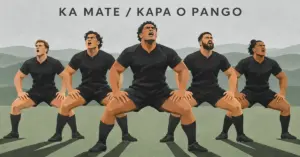
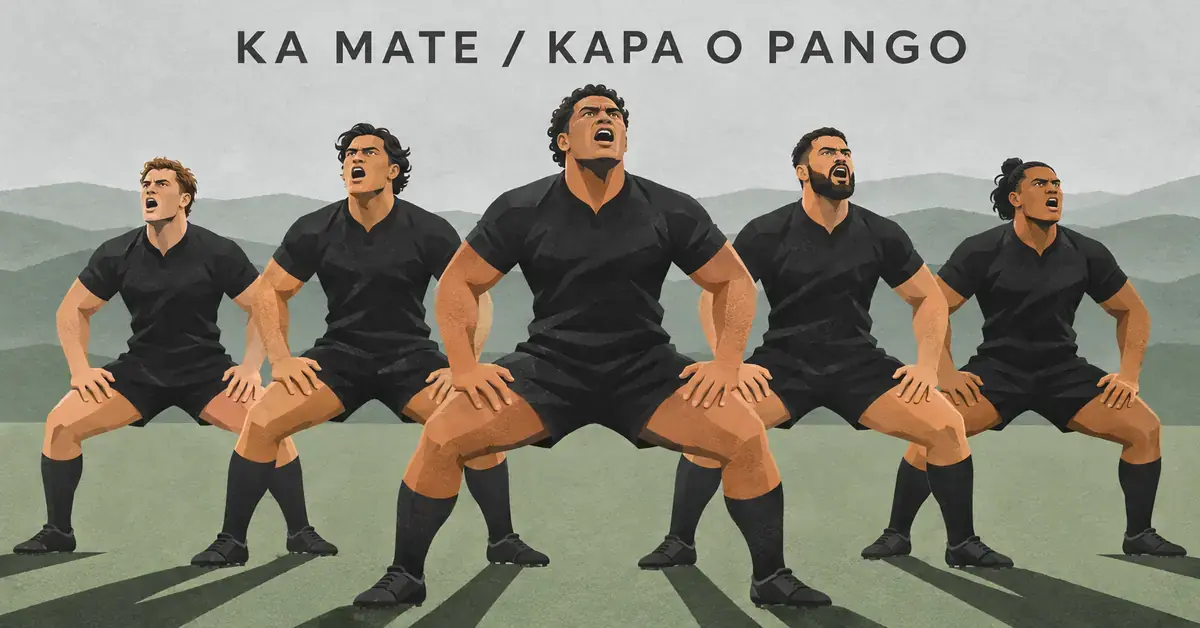
The All Blacks haka is the pre-match Māori challenge that has opened New Zealand’s Test matches for well over a century. Today the team performs two haka — the historic Ka Mate and the purpose-written Kapa o Pango — and each has its own composer, story and meaning.
Key Facts
| What it is | A pre-match Māori haka (ceremonial posture dance) performed by the All Blacks |
|---|---|
| Haka performed | Ka Mate and Kapa o Pango |
| Ka Mate | Composed around 1820 by Te Rauparaha, a chief of Ngāti Toa |
| Kapa o Pango | Composed in 2005 by Derek Lardelli, of Ngāti Porou, for the team |
| First rugby use | New Zealand Native team, 1888–89; performed by the 1905 “Original” All Blacks |
| Legal recognition | Ka Mate is protected by the Haka Ka Mate Attribution Act 2014 |
What is a haka, and why do the All Blacks perform one?
A haka is a traditional Māori posture dance — a disciplined combination of chant, foot-stamping, body-slapping and fierce facial expression. It is often described as a war dance, but that is only part of the picture: Māori perform haka to welcome guests, mark funerals, celebrate achievements and issue a challenge (wero). The haka before a rugby Test belongs to this last tradition, a formal challenge laid down to the opposition.
For the All Blacks, the haka is both a challenge and a statement of identity. New Zealand Rugby describes it as a living tradition that has been woven into the national game for more than 130 years. It expresses whakapapa (genealogy), unity and mana (prestige, authority), and it gives the team a shared moment of focus in the seconds before kick-off. The players do not invent the words: both haka are rooted in Māori culture and were composed by named Māori authorities.
The All Blacks are not the only New Zealand side with a haka. New Zealand Rugby lists Ko Uhia Mai for the Black Ferns, the women’s national team, and Te Tīmatanga for the Māori All Blacks, whose heritage also runs through the Māori All Blacks jersey.
Ka Mate: the story behind rugby’s most famous haka
Ka Mate is the haka most people picture when they think of the All Blacks, and it is older than the team itself. Its words are a story of survival, gratitude and the triumph of life over death.
Who composed Ka Mate, and when?
Ka Mate was composed around 1820 by Te Rauparaha, a rangatira (chief) and war leader of the Ngāti Toa iwi (tribe). Its origins sit deep within the oral histories of Ngāti Toa and Ngāti Tūwharetoa, and the haka carries themes of survival, the protective power of women and the victory of life over death.
What is the story behind the words?
The best-known account tells of Te Rauparaha fleeing enemies who were pursuing him. He was sheltered by another chief, Te Wharerangi, who hid him in a kūmara (sweet potato) storage pit. Te Wharerangi’s wife, Te Rangikoaea, sat over the entrance, shielding him both physically and spiritually. As the searchers drew near, Te Rauparaha is said to have muttered “Ka mate, ka mate” (it is death, it is death); when they passed and he realised he would survive, this turned to “Ka ora, ka ora” (it is life, it is life). Ngāti Toa tradition holds that the haka honours both Te Wharerangi and the spiritual strength of Te Rangikoaea. Details of the story vary between tellings, as oral traditions do, but the core meaning of resilience and renewal is constant.
Ka Mate lyrics and English translation
These are the words of Ka Mate in te reo Māori, as published by New Zealand Rugby:
- Ka mate, ka mate! ka ora! ka ora!
- Ka mate! ka mate! ka ora! ka ora!
- Tēnei te tangata pūhuruhuru
- Nāna nei i tiki mai whakawhiti te rā
- Ā, upane! ka upane!
- Ā, upane, ka upane, whiti te ra!
And the English translation:
- I die! I die! I live! I live!
- I die! I die! I live! I live!
- This man of men
- Who summons the sun and makes it shine
- A step upward, another step upward!
- A step upward, another… the sun shines!
When did a New Zealand team first perform Ka Mate?
A New Zealand rugby side first took a haka onto international tours in the late 1800s. According to New Zealand Rugby, Ka Mate was performed by the 1888–89 New Zealand Native team — a touring side largely made up of Māori players, an ancestor of today’s Māori All Blacks — and by the 1905 “Original” All Blacks, becoming a defining part of the country’s rugby culture. The haka was performed inconsistently for decades. A turning point came in 1987, when players Wayne “Buck” Shelford and Hika Reid led a revival that restored its intensity and cultural integrity, setting the standard the team keeps today.
Kapa o Pango: the haka written for the All Blacks
Kapa o Pango is the All Blacks’ second haka, and unlike Ka Mate it was created specifically for the team. Where Ka Mate is a centuries-old challenge the team inherited, Kapa o Pango is a modern, ceremonial haka about the players themselves.
Who composed Kapa o Pango, and when was it first performed?
Kapa o Pango was composed by Derek Lardelli, a leading authority in tikanga Māori (Māori custom and protocol) from the Ngāti Porou iwi, who developed it over the course of about a year in close collaboration with the team. The All Blacks performed Kapa o Pango for the first time in 2005, ahead of a Tri Nations Test against South Africa at Carisbrook in Dunedin, led by captain Tana Umaga. The name translates as “team in black”, and its words draw on the land of Aotearoa, the silver fern and the unity of those who wear the jersey. It made its debut in one of rugby’s fiercest contests, the All Blacks vs Springboks rivalry.
Kapa o Pango lyrics and translation
The words of Kapa o Pango in te reo Māori, as published by New Zealand Rugby:
- Taringa whakarongo!
- Kia rite! Kia rite! Kia mau!
- Hi!
- Kia whakawhenua au i ahau!
- Hi, aue! Hi!
- Ko Aotearoa, e ngunguru nei!
- Hi, au! Au! Aue, ha! Hi!
- Ko Kapa o Pango, e ngunguru nei!
- Hi, au! Au! Aue, ha! Hi!
- I ahaha!
- Ka tu te ihi-ihi
- Ka tu te wanawana
- Ki runga i te rangi, e tu iho nei, tu iho nei, hi!
- Ponga ra!
- Kapa o Pango! Aue, hi!
- Ponga ra!
- Kapa o Pango! Aue, hi!
- Ha!
And the English translation New Zealand Rugby publishes alongside it:
- Let me go back to my first gasp of breath
- Let my life force return to the earth
- It is New Zealand that thunders now
- And it is my time!
- It is my moment!
- The passion ignites!
- This defines us as the All Blacks
- And it is my time!
- It is my moment!
- The anticipation explodes!
- Feel the power
- Our dominance rises
- Our supremacy emerges
- To be placed on high
- Silver fern!
- All Blacks!
- Silver fern!
- All Blacks!
- aue hi!
- Ha!
Why was Kapa o Pango’s ending controversial?
The ending of Kapa o Pango became the most debated gesture in world rugby. In the original 2005 version, a player drew a thumb across the throat, a movement many spectators read as miming the cutting of a throat, and critics argued it looked violent. According to RNZ, the gesture was seen as too aggressive and too potentially controversial and was taken away soon after the haka was introduced. The throat movement is no longer part of the way the team performs Kapa o Pango.
Ka Mate vs Kapa o Pango: how the two haka compare
The two haka differ in age, authorship and purpose. Ka Mate is an inherited challenge with roots two centuries deep; Kapa o Pango is a modern, ceremonial piece written for the men who wear the black jersey. The table below sets them side by side.
Ka Mate vs Kapa o Pango
| Feature | Ka Mate | Kapa o Pango |
|---|---|---|
| Composer | Te Rauparaha (Ngāti Toa) | Derek Lardelli (Ngāti Porou) |
| Composed | Around 1820 | 2005 |
| Origin | Traditional haka, older than the team | Written specifically for the All Blacks |
| First performed by the team | Native team 1888–89; “Original” All Blacks 1905 | 2005 v South Africa, Carisbrook |
| Theme | Survival and the triumph of life over death | Identity, the silver fern and the team in black |
| Use today | Still performed to this day | Performed at the team’s discretion |
| Legal status | Haka Ka Mate Attribution Act 2014 | No specific legislation |
Who leads the All Blacks haka?
The haka is led by a designated player, not always the captain. The leader calls the opening commands — lines such as “Kia rite!” (be ready) — and the rest of the team answers with the chant, the stamping and the actions in unison. The role usually falls to a senior player with strong knowledge of the haka and the standing to lead it. Tana Umaga, for example, captained the side that first performed Kapa o Pango in 2005, while the 1987 revival of Ka Mate was driven by Wayne Shelford and Hika Reid. The leader sets the timing and intensity, and the players around them build the energy to a peak just before kick-off.
How do opposing teams respond to the haka?
Opponents are not required to do anything, and most teams stand in a line, arms linked, and watch. Over the years, though, the response to the haka has produced some of rugby’s most famous pre-match moments:
- Ireland, 1989: At Lansdowne Road, Ireland captain Willie Anderson led his team forward in a V-shape until he was almost nose to nose with Buck Shelford’s All Blacks.
- England, 1997: At Old Trafford, England hooker Richard Cockerill stepped forward and stood face to face with his opposite number, Norm Hewitt.
- France, 2007: France stood and faced the haka in Cardiff before stunning New Zealand 20–18 in the Rugby World Cup quarter-final — one of the great upsets in the history of the All Blacks vs France fixture.
- Wales, 2008: Wales refused to move after the haka ended, holding a long stare-down at the Millennium Stadium before the All Blacks won 29–9.
- France, 2011: At the Rugby World Cup final — played at the All Blacks’ unbeaten fortress at Eden Park — France advanced in a V-shape across the halfway line and were fined for crossing it.
- England, 2019: England formed a V-shaped arrowhead to receive the haka, then beat New Zealand in the World Cup semi-final; with several players across halfway, the team was later fined.
Because some responses crossed the line — literally — World Rugby now limits how teams may react. Under the guidance quoted by Planet Rugby from World Rugby’s match-commissioner programme, where one team performs a cultural challenge no player from that team may cross their own 10-metre line and no player from the receiving team may cross the halfway line.
Who owns Ka Mate? The Ngāti Toa attribution law
Ka Mate is legally recognised as belonging to Ngāti Toa. The Haka Ka Mate Attribution Act 2014 — the first New Zealand law of its kind — came out of Ngāti Toa’s Treaty of Waitangi settlement with the Crown and gives the iwi a “right of attribution” over the haka.
That right is narrow and specific. It applies to the publication of Ka Mate for commercial purposes, the communication of Ka Mate to the public, and any film featuring Ka Mate that is shown or issued publicly. In those cases, a clear and reasonably prominent statement must record that Te Rauparaha composed Ka Mate and was a chief of Ngāti Toa Rangatira. Importantly, the right of attribution does not restrict live performance — including by kapa haka groups, schools or sports teams — and does not cover educational use, criticism, review or news reporting. The All Blacks’ continued use of Ka Mate sits within a separate agreement between Ngāti Toa and New Zealand Rugby.
Respect for Ka Mate’s origins also shapes where it is performed. Because of Te Rauparaha’s history in the South Island, RNZ reports that performing Ka Mate in Te Waipounamu (the South Island) can be seen as disrespectful, which is why the All Blacks are no longer seen performing it there. Kapa o Pango, by contrast, has no specific legislation attached to it.
Sources
- New Zealand Rugby (AllBlacks.com) — The Haka
- AllBlacks.com — Ka Mate
- AllBlacks.com — Kapa o Pango
- AJ Park — The Haka Ka Mate Attribution Act: the right of attribution
- RNZ — To haka, or not to haka? Who has the mana to decide?
- World Rugby — How France “choked” the All Blacks (2007 quarter-final, 20–18)
- Planet Rugby — Why teams are no longer allowed to advance during the cultural challenge
- The Irish Times — In 1989 Ireland faced the Haka and paid the price
- NZ Herald — Richard Cockerill on the 1997 Old Trafford haka face-off with Norm Hewitt
- RugbyDump — The Welsh response to the All Blacks haka (2008, 29–9)
- NZ Herald — France fined for advancing on the haka at the 2011 World Cup final
- The Irish Times — England fined for V-shaped formation when facing the haka (2019)
Frequently asked questions (FAQ)
What does the All Blacks haka mean?
The two haka carry different meanings. Ka Mate tells a story of survival and the triumph of life over death, drawn from Te Rauparaha’s escape from his pursuers. Kapa o Pango is a ceremonial haka about the team itself, speaking of the land of Aotearoa, the silver fern and the players who wear the black jersey.
Who composed the All Blacks haka?
Ka Mate was composed around 1820 by Te Rauparaha, a chief of the Ngāti Toa iwi. Kapa o Pango was written for the team in 2005 by Derek Lardelli, an authority in tikanga Māori from Ngāti Porou.
Can schools and amateur teams perform Ka Mate?
Yes. The Haka Ka Mate Attribution Act 2014 does not restrict performance, including by school groups, kapa haka groups or sports teams. It only requires that qualifying commercial publications credit Te Rauparaha and Ngāti Toa.