
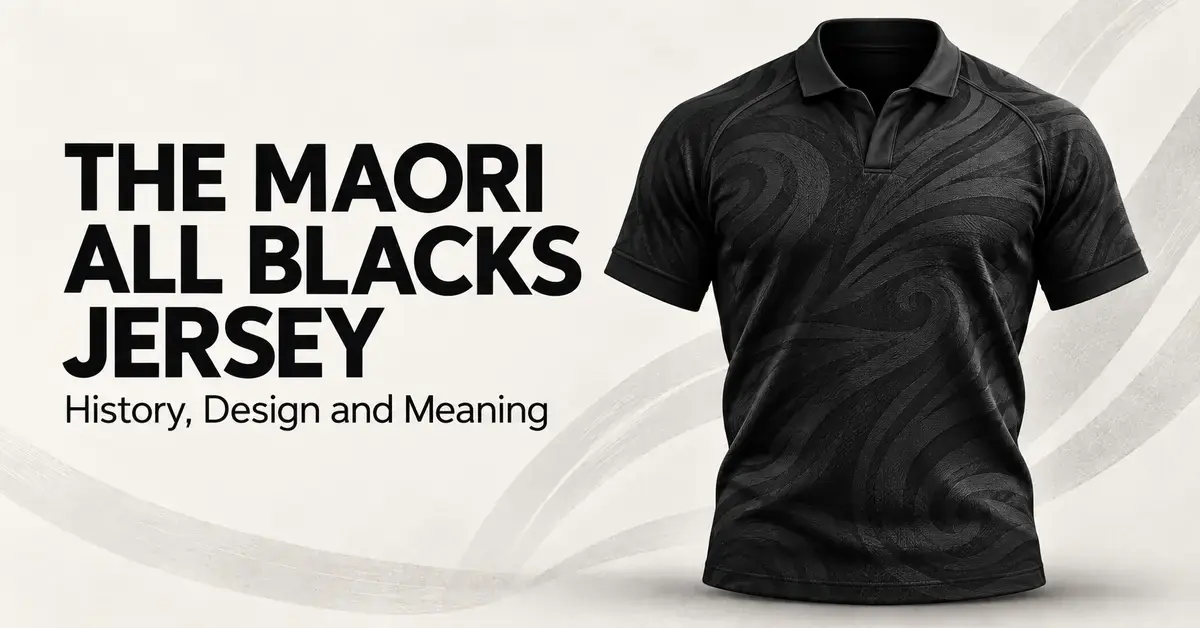
The Maori All Blacks jersey is the black playing kit worn by New Zealand’s national Maori rugby union team, marked by a silver fern and, in recent years, custom Maori artwork woven into the fabric. It is one of the oldest and most culturally loaded shirts in world rugby: the black-and-silver-fern look now associated with all New Zealand teams was worn by a mostly Maori side on tour more than a decade before it became the national standard. This guide explains where the jersey came from, how the modern design is created and what its patterns mean, who is allowed to wear it, the difficult history attached to it, and how supporters can buy an official replica today.
Key Points
- Origin: the black-and-silver-fern jersey was worn by the mostly Maori 1888–89 New Zealand Native team before it became the national uniform.
- Name: the side was the “New Zealand Maori” until it was rebranded the Maori All Blacks in 2012; it gained official status in 1910.
- Eligibility: only players with verified Maori whakapapa (genealogy) can wear it.
- 2025 design: “Te Tauihu Matua” by artist Kahurangi Falaoa, built around the bow of a waka taua and made by adidas.
- Haka: the team performs Te Timatanga (“The Beginning”), introduced in 2001.
What is the Maori All Blacks jersey?
The Maori All Blacks jersey is the match kit of a representative side made up of players who have Maori whakapapa (genealogy). The team is run by New Zealand Rugby alongside the senior All Blacks structure, but it is a separate side with its own identity, its own haka and its own kit. The current name is fairly recent: the team played for most of its life as “New Zealand Maori” and was only rebranded the Maori All Blacks in 2012.
Unlike a normal club or franchise shirt, the jersey is treated by the players as a taonga (treasure) rather than merchandise. The reason is partly historical — a Maori-dominated team wore black with a silver fern on the world stage before the concept of “the All Blacks” existed — and partly cultural, because the modern shirt carries commissioned artwork that records genealogy and tribal identity. For a fuller picture of the side itself, its squads and its record, see our overview of the Maori All Blacks team.
The history behind the black jersey and the silver fern
The black jersey with a silver fern was worn by a Maori side before it was ever the national uniform. Understanding that origin is the key to why the modern kit carries so much weight.
The 1888–89 New Zealand Native team
The look traces back to the New Zealand Native Football Team of 1888–89, a predominantly Maori squad that became the first New Zealand representative side to tour Britain. Organised by businessman Thomas Eyton and player Joe Warbrick, the team played an extraordinary 107 matches across England, Ireland, Wales, Australia and New Zealand over roughly 14 months. They were also the first New Zealand team to perform a haka and the first to play in a black uniform, a pioneering role also recorded on Wikipedia.
Player Thomas Ellison is widely credited with putting the silver fern on the black jersey, and in 1893 he proposed at the first annual meeting of the New Zealand Rugby Football Union that the national side should play in black with a silver fern. In other words, the emblem the whole rugby world now reads as “New Zealand” was pioneered by a Maori touring team. The early jerseys themselves were heavy wool, chosen to cope with Northern Hemisphere winters, and black hid the mud across relentless back-to-back fixtures.
From New Zealand Maori to the Maori All Blacks
The representative Maori team was given official status in 1910, a century of continuous history the side marked with its 2010 centenary. For most of that time it was known as the New Zealand Maori (earlier still, the New Zealand Maoris). The switch to the current name, the Maori All Blacks, came in 2012 and deliberately tied the side more closely to the global All Blacks brand while keeping its distinct cultural role. The jersey has evolved from plain black wool to a lightweight synthetic shirt covered in sublimated (printed-into-the-fabric) Maori artwork, but the black base and the fern have never left it.
How the modern Maori All Blacks jersey is designed
The modern jersey is not a generic template with a logo added — New Zealand Rugby commissions Maori artists to create bespoke artwork for it, so each design tells a specific story. The kit is made in partnership with adidas, New Zealand Rugby’s long-time apparel supplier, and the artwork is printed across the shirt rather than stitched on as a badge.
“Te Tauihu Matua”: the 2025 design
The 2025 jersey design is called “Te Tauihu Matua,” which translates as something close to “The Chiefly Bow.” It was created by contemporary Maori artist and haka composer Kahurangi Falaoa. The concept is built around the tauihu — the carved bow of a waka taua (war canoe) — and draws on a well-known saying about standing at the bow of your canoe to feel the spray of the future, an image of forward-facing leadership. The jersey was blessed in Wellington before its release and debuted in the Maori All Blacks’ mid-2025 fixtures against Japan and Scotland.
What the motifs mean
The recurring elements in recent Maori All Blacks jerseys are drawn from traditional carving and kowhaiwhai (painted scroll) patterns. The table below sets out the main motifs used in the “Te Tauihu Matua” design and what they represent.
| Motif | What it is | What it represents |
|---|---|---|
| Manaia (two figures) | Stylised guardian figures placed on the front of the shirt | The balance between Tu (associated with war) and Rongo (associated with peace) |
| Puhoro | Split-spiral kowhaiwhai line work | Speed and agility, echoing water rippling past a moving waka |
| Tetekura | The carved figurehead at the bow of the canoe | Leadership, unity and the courage to lead through rough water |
| Silver fern | The historic New Zealand emblem, retained on every kit | Continuity with the 1888 side and national identity |
Who is allowed to wear the Maori All Blacks jersey?
The single rule that sets this jersey apart is that a player must have verified Maori whakapapa (genealogy) to wear it. Eligibility is not based on where a player lives, their passport or a transfer window — it is based on demonstrable Maori ancestry, which is confirmed before selection. This makes pulling on the shirt an act of ancestral connection as much as a sporting selection.
A few points are worth clarifying, because they are often misunderstood:
- Ancestry is verified for every player before they are selected; the requirement is genealogical connection to a recognised iwi (tribe) or hapu (sub-tribe).
- Players are not required to be signed to a New Zealand competition to be eligible for the Maori side — that residency-style rule belongs to the senior All Blacks selection policy, not to the Maori team.
- Representing the Maori All Blacks does not use up a player’s eligibility for the senior All Blacks or their province; many players wear both jerseys in their careers, and the Maori side has long been a development stage toward higher honours.
A painful history: exclusion from South Africa
The jersey also carries the memory of one of New Zealand rugby’s darkest chapters. Because apartheid-era South Africa’s racial laws would not accept non-white opponents, New Zealand’s rugby union agreed to leave Maori players out of All Blacks touring squads to South Africa in 1928, 1949 and 1960.
The most famous casualty was the great fullback George Nepia, kept home in 1928 despite being one of the best players in the world. The 1960 tour drew the mass “No Maoris, No Tour” protest campaign, and players who did travel on later tours such as 1970 were given the demeaning label of “honorary whites.” Against that backdrop, the independent Maori fixtures became a stage where excluded players could still show their class. This history is part of the long, fraught relationship between the All Blacks and the Springboks. In 2025, South Africa Rugby announced it would formally apologise to the Maori players shut out during those years.
Famous matches in the jersey
The side has a long record of upsetting touring giants, often playing a looser, more expansive game than the tightly structured senior team. A handful of results stand out.
| Year | Opponent | Result | Note |
|---|---|---|---|
| 1926 | France | Won 12–3 (Paris) | A highlight of the long European tour of 1926–27 |
| 2005 | British & Irish Lions | Won 19–13 (Hamilton) | The team’s first win over the Lions; Leon MacDonald scored the only try |
| 2010 | Ireland & England | Won 31–28 and 35–28 | Centenary-series wins marking 100 years of the side |
| 2022 | Ireland | Won 32–17 (Hamilton) | An early blow in Ireland’s 2022 tour of New Zealand |
The 1926 win in Paris is one of the earliest chapters in the story of the All Blacks and France, a fixture the senior side would go on to make famous.
Te Timatanga: the haka worn with the jersey
The Maori All Blacks perform their own haka, Te Timatanga, rather than the senior team’s “Ka Mate” or “Kapa o Pango.” Te Timatanga means “The Beginning,” and it was introduced in 2001, composed for the side by team kaumatua (elder) Whetu Tipiwai. It tells a Maori creation story — the evolution of life and the emergence of New Zealand — and connects the players to their ancestors through whakapapa.
Because eligibility for the jersey is itself based on genealogy, the haka and the shirt reinforce the same idea: the players are representing not just a team but a lineage. That is why the jersey and the pre-match challenge are treated as a single cultural statement rather than as entertainment.
How to buy the Maori All Blacks jersey
Official Maori All Blacks replica jerseys are made by adidas and sold through New Zealand Rugby’s official channels. The 2025 adult replica launched at around NZD 170, with cheaper junior and youth sizes; prices vary by retailer and over time, and player-issue versions differ from the fan replica. The specification box below summarises the key details of the current kit.
Quick Facts
| Team | Maori All Blacks (formerly New Zealand Maori) |
|---|---|
| Apparel maker | adidas, in partnership with New Zealand Rugby |
| 2025 design name | Te Tauihu Matua (“The Chiefly Bow”) |
| Designer | Kahurangi Falaoa (contemporary Maori artist) |
| Base colour | Black with a silver fern and sublimated Maori artwork |
| Adult replica price (2025) | Around NZD 170 (junior/youth cheaper; varies by retailer) |
| Where to buy | Official New Zealand Rugby and adidas stores — allblackshop.com |
Replica versus player-issue, and looking after it
There are two versions of most rugby shirts, and it helps to know which you are buying. The player-issue (or “authentic”) jersey is a tighter, performance-cut shirt built to resist grabbing in the tackle; the replica is a slightly more relaxed fit made for everyday wear while keeping the same artwork. To protect the printed design, wash a replica cold and inside out, avoid the tumble dryer and skip fabric softener, which can dull sublimated patterns over time. If you are building a wider match-day kit, our guide to rugby boots covers footwear rules and fit in the same practical way.
Common mistakes and misconceptions
A few misunderstandings come up repeatedly about this jersey, and clearing them up helps you both appreciate and shop for it accurately.
- Thinking the name is old. The “Maori All Blacks” name only dates from 2012; before that the side was the New Zealand Maori, so older jerseys and records use the earlier name.
- Assuming the All Blacks copied the Maori side’s colours by chance. The black-and-fern look was pioneered by the 1888 Native team; the national side adopted it afterward.
- Believing the patterns are decorative. The motifs are commissioned artwork with specific meaning, not generic “tribal” graphics; treating them as fashion print misses the point.
- Confusing player-issue with replica. Paying a premium expecting the tight authentic cut when you have bought the fan replica (or vice versa) is a common online mistake.
- Trusting unofficial sellers. Counterfeit rugby jerseys are common; buying outside adidas or New Zealand Rugby’s official stores risks poor fabric, distorted artwork and no guarantee.
Sources
- AllBlacks.com — Behind the Design: Maori All Blacks jersey “Te Tauihu Matua”
- AllBlacks.com — Te Timatanga: the Maori All Blacks haka explained
- New Zealand Rugby — Maori rugby teams
- Te Papa — Before the All Blacks: the New Zealand Natives
- Te Ara Encyclopedia of New Zealand — New Zealand Native Football team, 1888–89
- Planet Rugby — 2025 Maori All Blacks kit unveiled and where to buy it
- Planet Rugby — Lions flashback: Maori All Blacks 19–13 Lions (2005)
- RNZ — South Africa Rugby to apologise to Maori players excluded by apartheid
Frequently Asked Questions (FAQ)
Who can wear the Maori All Blacks jersey?
Only players with verified Maori whakapapa (genealogy) can be selected. Ancestry is confirmed before selection, so eligibility is based on genealogical connection to a Maori iwi or hapu rather than on residency, nationality or which competition a player is contracted to.
Who designed the 2025 Maori All Blacks jersey?
The 2025 jersey, titled “Te Tauihu Matua” (The Chiefly Bow), was designed by contemporary Maori artist and haka composer Kahurangi Falaoa. It centres on the carved bow of a waka taua and features two manaia guardian figures representing the balance of Tu and Rongo.
Why do the Maori All Blacks wear black with a silver fern?
The black jersey with a silver fern was first worn by the predominantly Maori New Zealand Native team on their 1888–89 tour, with Thomas Ellison credited for the fern on black. The national side adopted the look afterward, so the Maori team’s jersey is effectively the origin of New Zealand’s rugby colours.
How much does an official Maori All Blacks jersey cost?
The 2025 adult adidas replica launched at around NZD 170, with cheaper junior and youth sizes. Prices vary by retailer and season, and the tighter player-issue “authentic” version is sold separately from the standard fan replica.
What is the Maori All Blacks haka called?
The team performs Te Timatanga, meaning “The Beginning.” It was introduced in 2001 and composed for the side by kaumatua Whetu Tipiwai, telling a Maori creation story that links the players to their ancestors through whakapapa. It is different from the senior All Blacks’ “Ka Mate” and “Kapa o Pango.”