
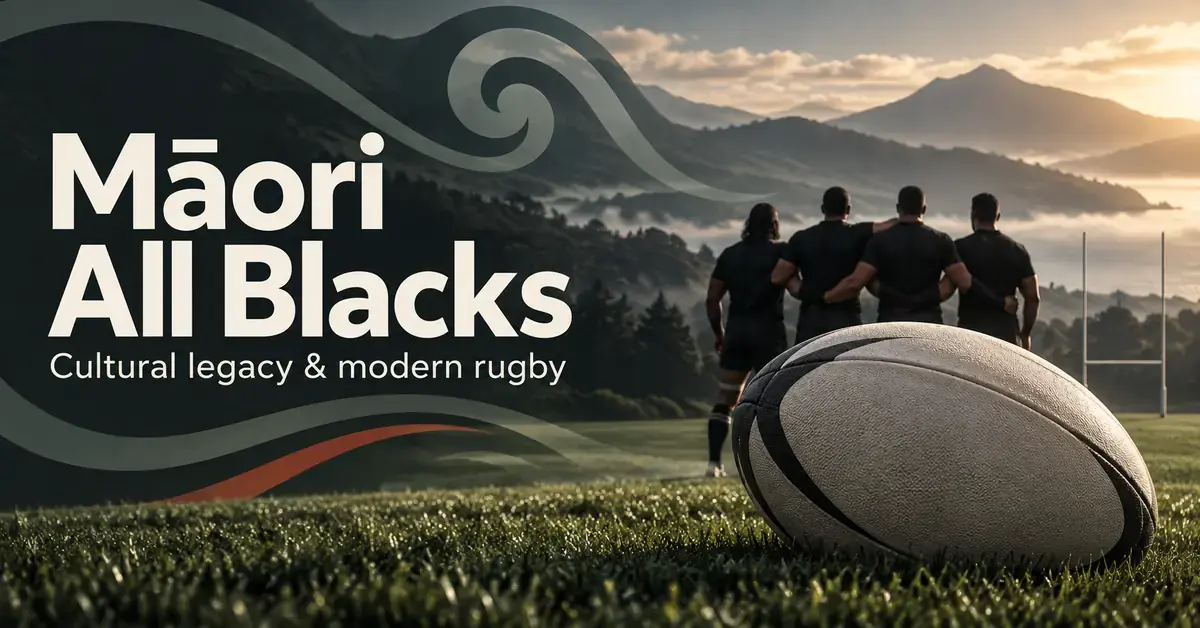
The Maori All Blacks are New Zealand’s representative rugby side for players of Māori descent, and one of the few elite teams in world sport chosen by ancestry rather than by residency or citizenship. Every player selected must have verified Māori whakapapa (genealogy), which turns a place in the squad into a cultural honour as much as a sporting one.
The team is run under New Zealand Rugby alongside dedicated Māori rugby governance, and it plays two roles at once: a proving ground that feeds talent toward the senior national side, and a genuine international force that has beaten the British & Irish Lions, Ireland, England and other tier-one nations. This guide explains where the team came from, how eligibility works, how the modern squad is picked, the meaning of its haka, and the difficult history it has lived through.
Quick Facts
| Team | Maori All Blacks (Māori All Blacks) |
|---|---|
| Formerly known as | New Zealand Māori / New Zealand Maoris |
| Origins | 1888–89 New Zealand Native football team |
| First official team | 1910 |
| Renamed Māori All Blacks | 2012 |
| Eligibility | Verified Māori whakapapa (ancestry) |
| Haka | Te Tīmatanga (introduced 2001; written by Whetu Tipiwai) |
| Governance | New Zealand Rugby with Māori rugby governance |
| First win over the Lions | 2005 – 19–13 in Hamilton |
Who are the Maori All Blacks?
The Maori All Blacks are an invitational New Zealand team open only to players with confirmed Māori ancestry. They do not play in a permanent annual league; instead they assemble for short mid-year or end-of-year windows to face touring nations and international invitational sides. The name in its current form dates only to 2012 – before that the team was known as New Zealand Māori (and earlier the New Zealand Maoris).
Because the side is picked for specific fixtures rather than a season-long campaign, its identity rests on two things that never change: the ancestry requirement, and an intense programme of cultural preparation that shapes how the team trains, travels and plays.
The historic foundations of Maori rugby
Māori involvement in rugby is almost as old as the game in New Zealand itself. The pivotal moment came in 1888–89, when the New Zealand Native football team, organised by Joseph Warbrick, undertook a marathon tour of New Zealand, Australia and the British Isles. By the time they returned home in August 1889 they had played 107 matches and won 78 of them – an endurance schedule with no modern equivalent.
That side left two lasting marks on New Zealand rugby: it was the first New Zealand team to wear an all-black uniform, and the first to perform a haka on tour. A formally recognised New Zealand Māori team was then selected in 1910, which is the point most historians treat as the start of the official representative lineage.
Key milestones in the team’s history
| Year | Milestone | Why it mattered |
|---|---|---|
| 1888–89 | New Zealand Native tour of Britain, Australia and NZ | First NZ side to wear all black and to perform a haka abroad; 107 matches played. |
| 1910 | First officially recognised New Zealand Māori team | Established the formal representative side under union administration. |
| 1926–27 | Long tour of France, Britain, Australia, Ceylon and British Columbia | Around 40 matches; the French adopted elements of the Māori attacking style. |
| 2001 | Introduction of the haka Te Tīmatanga | Gave the team its own dedicated pre-match challenge. |
| 2012 | Rebranded as the Māori All Blacks | Aligned the side with the All Blacks name while keeping its distinct identity. |
The 1888–89 Native tour in more detail
The Natives began as a private commercial venture rather than a union project, driven by player-organiser Joe Warbrick and backer Thomas Eyton. Travelling for roughly 14 months, the squad faced fixture congestion and fatigue that would be unthinkable today, yet still won the large majority of its games. Just as importantly, it showed British crowds a New Zealand style of play and introduced them to Māori custom, laying the groundwork for every national touring side that followed. Tom Ellison, a member of that team, would go on to captain the first officially sanctioned New Zealand representative side in 1893.
How does whakapapa eligibility work?
Eligibility for the Maori All Blacks is decided by ancestry, not by where a player lives or which passport they hold. To be considered, a player must be able to demonstrate Māori whakapapa – a genealogical connection to a recognised iwi (tribe) or hapū (sub-tribe). This single rule is what separates the team from almost every other elite side, where eligibility can shift with residency periods or heritage transfers.
- Ancestral connection, not blood percentage: selection is based on a genuine, traceable link to an iwi, not an arbitrary blood-quantum threshold.
- Documentation and verification: players record their ancestral lines, which are checked with the help of cultural advisors and elders before selection is confirmed.
- No barrier to other honours: playing for the Maori All Blacks does not tie a player down – they remain fully eligible for the senior All Blacks and their provincial and Super Rugby teams.
Verifying Māori ancestry today
In the amateur era, ancestry was often recognised informally within provincial rugby communities. The professional game required something more robust, so verification now runs through New Zealand Rugby in consultation with cultural experts and kaumātua (elders). A player nominates their ancestral lines, whānau and advisors help compile the supporting genealogy, and that record is reviewed before eligibility is granted. For many young players the process becomes a meaningful journey into their own family history rather than a box-ticking exercise.
Key Points
- The Maori All Blacks are picked only from players with verified Māori ancestry – unique among elite rugby teams.
- The lineage traces to the 1888–89 Native tour; the official team dates to 1910 and the current name to 2012.
- Their haka, Te Tīmatanga, was introduced in 2001 and is distinct from the senior All Blacks’ Ka Mate.
- Māori players were excluded from South Africa tours in 1928, 1949 and 1960 under apartheid-era pressure.
- The team beat the British & Irish Lions for the first time in 2005 and serves as a pathway to the senior All Blacks.
How is the modern squad selected?
Modern selection is built around Super Rugby form. Because the team gathers only for short windows, the coaches monitor eligible players across the five New Zealand franchises – the Blues, Chiefs, Hurricanes, Crusaders and Highlanders – and pick a squad that blends experienced leaders with emerging talent. Versatility is prized, since compact tour schedules leave little room for narrow specialists.
The result is usually a mix of established internationals using the fixtures to stay sharp and younger players auditioning for higher honours. Selectors weigh current form against long-term potential, knowing that a strong showing here is one of the clearest routes onto the national selectors’ radar.
Balancing professional rugby with cultural values
The team’s biggest operational challenge is transition. Players arrive from metrics-driven professional franchises into an environment where wānanga (learning forums), te reo Māori practice and marae protocols sit at the centre of the week. Rather than treating this as a distraction, the coaching staff view it as the source of the side’s cohesion – the reason a group drawn from rival franchises can unite quickly. Values such as whanaungatanga (kinship and belonging), manaakitanga (care and hospitality) and kaitiakitanga (guardianship) are used deliberately to build trust and accountability before a ball is kicked.
The haka Te Tīmatanga and cultural identity
The Maori All Blacks perform their own haka, Te Tīmatanga, rather than the “Ka Mate” or “Kapa o Pango” associated with the senior All Blacks. Introduced in 2001 and written for the team by kaumātua Whetu Tipiwai, its name means “the beginning”, and it tells the story of creation and the making of New Zealand from the four winds – connecting the players to their origins through whakapapa.
The haka is a ceremonial act, not a piece of theatre for the cameras. Throughout the week players study its meaning, learn waiata (songs) and receive guidance from elders, so that by match day the performance is an authentic expression of collective identity. Familiar features carry specific meaning: pūkana (widened, glaring eyes) signals focus and defiance, while trembling hands convey life force and energy.
Why were Māori players excluded from South Africa tours?
The story is not only one of triumph. For much of the twentieth century, Māori players paid a direct price for New Zealand’s sporting ties with apartheid-era South Africa, whose racial laws would not accept a fully integrated touring team. The New Zealand Rugby Football Union responded by selecting no Māori players for its tours of South Africa in 1928, 1949 and 1960.
The consequences were personal and profound. The great fullback George Nēpia – widely regarded as one of the finest players of his generation – was declared ineligible for the 1928 tour purely because he was Māori, and he had already been controversially omitted from the 1926 side. The 1960 tour prompted the “No Maoris, No Tour” protest campaign, and in 1970 a small number of Māori and Pasifika players were finally admitted to a South African tour under the demeaning label of “honorary whites”. These events fed directly into the wider anti-apartheid movement that later shaped the divisive 1981 Springbok tour of New Zealand; the long, complicated relationship between the two rugby nations is explored further in our history of the All Blacks vs Springboks rivalry.
Famous victories over touring nations
Freed from some of the caution that can constrain a full national side, the Maori All Blacks have built a reputation for expansive, attacking rugby that has repeatedly caught out tier-one visitors. Several results stand out:
- 1926–27 tour: wins in Europe that spread the team’s reputation and influenced how France approached the game.
- 2005 – British & Irish Lions 13, Maori 19 (Hamilton): the side’s first-ever win over the Lions, in a match billed as a fourth Test.
- 2010 centenary series: a 31–28 win over Ireland in Rotorua and a 35–28 win over England in Napier, marking 100 years of the official team.
- 2022: a 32–17 win over Ireland in Hamilton, before Ireland took the second game 30–24.
- 2024–25: a home-and-away split with a Japan XV in 2024 (won 36–10, lost 26–14), then a 53–20 win over a Japan XV and a narrow 29–26 loss to Scotland in 2025.
The 2005 win over the Lions
The Lions arrive in New Zealand only about once every twelve years, which makes selection for that fixture a career highlight. In 2005 a Maori side captained by Jono Gibbes and featuring players such as Carlos Spencer, Leon MacDonald and Luke McAlister held on for a 19–13 win in Hamilton – the first time a Māori team had beaten the Lions. Built on ferocious defence and clinical goal-kicking, it remains the benchmark result in the team’s modern history.
Leaders and legends of Maori rugby
Leadership in this team carries responsibilities beyond the usual captain’s duties, bridging the coaching staff, the players and the elders who guide the group. The table below lists figures whose roles are well documented, focusing on their actual contribution rather than uncertain detail.
| Figure | Era | Role and contribution |
|---|---|---|
| Joe Warbrick | 1888–89 | Organiser and captain of the pioneering New Zealand Native team. |
| Tom Ellison | 1890s | Native tourist, rugby thinker and captain of the first official NZ team (1893). |
| George Nēpia | 1920s–30s | Iconic fullback; barred from the 1928 South Africa tour because he was Māori. |
| Wayne “Buck” Shelford | 1980s | Powerful No. 8 closely associated with restoring pride to the haka and the jersey. |
| Jono Gibbes | 2000s | Captain of the 2005 side that first beat the British & Irish Lions. |
| Ash Dixon | 2010s–20s | Long-serving modern captain who led the team through recent international windows. |
The line runs from Tom Ellison, whose early writing helped shape New Zealand’s approach to the game, through to modern leaders who combine professional standards with cultural mentorship. For the wider story of who has led New Zealand teams over the years, see our guide to the All Blacks captain.
A pathway to the senior All Blacks
New Zealand Rugby values the side as a development stage between Super Rugby and the top level. Stepping straight into the senior New Zealand national team can be daunting, and the Maori All Blacks give rising players a chance to experience international opposition, touring life and media pressure inside a supportive cultural environment. Recent internationals such as Rieko Ioane, Damian McKenzie and Codie Taylor all pulled on the jersey before becoming regular All Blacks, which is why national selectors watch these fixtures closely.
The jersey and its design
The Maori All Blacks kit has evolved from the plain black of the 1888 pioneers into a canvas for contemporary indigenous design, with artists working alongside the kit manufacturer to embed kōwhaiwhai (painted scroll patterns) and tā moko (tattoo) motifs that carry specific meaning. Because we cover the shirt in depth elsewhere, this is only a summary – for the full history, the meaning of recent designs and where to buy one, read our dedicated guide to the Maori All Blacks jersey.
Who governs the team?
The Maori All Blacks sit within New Zealand Rugby, which provides funding, logistics and scheduling, while Māori rugby governance guides cultural direction and eligibility. This shared arrangement is designed so that commercial decisions never override the cultural values and community obligations at the heart of the team. Revenue from tours also helps support Māori rugby at regional and grassroots level.
Common misconceptions about the Maori All Blacks
Several myths cloud the picture, so it is worth answering them directly.
- “They are the same as the All Blacks.” No. They are a separate representative side selected only from players of Māori descent, with their own haka and history.
- “You must be a certain percentage Māori.” No. Eligibility rests on a genuine, verifiable ancestral connection to an iwi, not a blood-quantum figure.
- “Playing for them blocks the senior All Blacks.” No. Players regularly move between the two, and the Maori All Blacks are treated as a development pathway.
- “They compete in a season-long tournament.” No. They assemble for occasional fixtures and tours rather than a fixed annual league.
- “They perform Ka Mate.” No. Their haka is Te Tīmatanga, written specifically for the team.
Together these points show why the side occupies a distinct place in New Zealand rugby: it is a competitive international team, a cultural institution and a talent pathway at the same time, and it has carried that identity from the exhausting tours of the nineteenth century to the professional fixtures of today.
Sources
Frequently Asked Questions (FAQ)
What are the eligibility rules for the Maori All Blacks?
A player must have verified Māori whakapapa – a genuine, traceable connection to a recognised iwi or hapū. Ancestral lines are documented and checked with cultural advisors and elders before selection, and eligibility is based on that connection rather than a blood-quantum percentage.
How are the Maori All Blacks different from the All Blacks?
The senior All Blacks are open to any player who meets New Zealand’s national eligibility rules, regardless of heritage. The Maori All Blacks are a separate side chosen only from players of Māori descent, with their own haka, their own history and a role as a development pathway toward the national team.
What is the name of the Maori All Blacks haka?
Their haka is Te Tīmatanga, meaning “the beginning”. It was introduced in 2001 and written for the team by kaumātua Whetu Tipiwai, and it tells the story of creation and the forming of New Zealand from the four winds.
Why were Māori players once excluded from tours to South Africa?
To satisfy apartheid-era South Africa’s racial laws, New Zealand’s union selected no Māori players for its South Africa tours in 1928, 1949 and 1960. In 1970 a few Māori and Pasifika players were admitted only as “honorary whites”, and the exclusions helped fuel New Zealand’s anti-apartheid protest movement.
When did the Maori All Blacks first beat the British & Irish Lions?
In 2005, when a side captained by Jono Gibbes won 19–13 in Hamilton. It was the first victory by a Māori team over the Lions and remains one of the most celebrated results in the team’s history.