



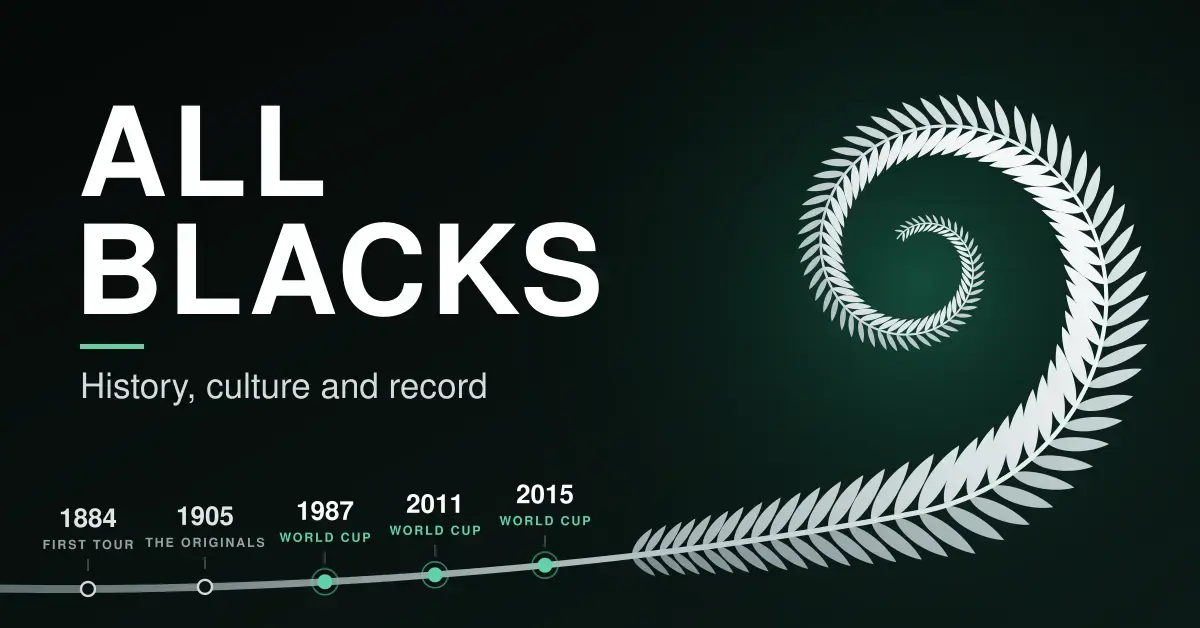
The All Blacks are the men’s national rugby union team of New Zealand and one of the most successful sides in the history of international sport. Instantly recognisable in their all-black kit, their silver fern and their pre-match haka, they have won three Rugby World Cups and hold one of the highest win rates of any team in any code. This guide explains who the All Blacks are, where they came from, how the team has evolved through its coaching eras, and the traditions and records that define it.
Who are the All Blacks?
The All Blacks are the senior men’s national representative team in rugby union for New Zealand, governed by New Zealand Rugby (NZR). The name refers to the team’s distinctive black jersey, shorts and socks, worn with a silver fern on the left breast. Players selected for the team earn a Test cap, and leading figures from the side go on to feature for New Zealand’s other representative teams.
Because the squad changes from season to season, the current playing group and the 2026 side are covered separately in our guide to New Zealand’s national rugby union team. This article focuses on the history, culture and overall record that sit behind the jersey.
Quick Facts
| Nickname | All Blacks |
|---|---|
| Sport | Rugby union (men’s national team) |
| Governing body | New Zealand Rugby (NZR) |
| First Test | 15 August 1903, beat Australia 22-3 in Sydney |
| Colours & emblem | Black kit with a silver fern |
| Rugby World Cup titles | 3 (1987, 2011, 2015) |
| Head coach (2026) | Dave Rennie (from June 2026, to the 2027 World Cup) |
| Kit supplier | adidas (since 1999) |
| Home fortress | Eden Park, Auckland (unbeaten in Tests since 1994) |
| Overall Test record | About 513 wins from roughly 671 Tests (~76%), to late 2025 |
The history of the All Blacks
New Zealand rugby grew from a single club match into an international force within a few decades. The story runs from the arrival of the game in the 1870s to the team’s first overseas tours and its first official Test.
Early rugby in New Zealand
Rugby was introduced to New Zealand in 1870, when Charles Monro, who had learned the game in England, organised the country’s first recognised match in Nelson. The sport spread quickly through schools and clubs, and in 1892 the New Zealand Rugby Football Union was formed to govern it nationally. A New Zealand team had already toured New South Wales in 1884, but a unified national body gave the game the structure it needed to compete internationally.
The first Test and the 1905 ‘Originals’
The All Blacks played their first official international, or Test, on 15 August 1903 against Australia at the Sydney Cricket Ground, winning 22-3. Two years later, the 1905-06 side toured Britain, Ireland, France and North America and won 34 of their 35 matches. That team, now known as the ‘Originals’, turned New Zealand rugby into a global name and set the standard of excellence that later generations tried to match.
Where the name ‘All Blacks’ comes from
The name ‘All Blacks’ dates from the 1905 tour. The most famous explanation, told by player Billy Wallace, is that a British newspaper described the team as playing as if they were ‘all backs’, and that a printing error turned this into ‘All Blacks’. Historians treat that story with caution, because the simplest explanation is the team’s all-black uniform. Either way, the name stuck and has been part of the team’s identity ever since.
The modern coaching eras
Since rugby union turned professional in 1995, the All Blacks have been shaped by a small number of long-serving head coaches. Each era built on the last, and the win record has stayed remarkably high throughout. The full roll-call is set out in our guide to the list of All Blacks coaches.
The Graham Henry era (2004-2011)
Graham Henry coached the All Blacks from 2004 to 2011 and ended a 24-year wait for a World Cup title. His side dominated the Tri-Nations and built the depth that paid off when New Zealand won the 2011 Rugby World Cup on home soil, beating France 8-7 in a tense Eden Park final. Henry’s win rate of around 85% was among the best in the sport at the time.
The Steve Hansen era (2012-2019)
Steve Hansen, Henry’s assistant, took over in 2012 and oversaw the most successful run in the team’s professional history. The All Blacks won the 2015 Rugby World Cup in England, becoming the first nation to win the tournament three times and the first to retain the title. Across his tenure Hansen’s teams won 93 of 107 Tests, a win rate of about 88%, and put together an unbeaten run of 18 Tests across 2015 and 2016. Earlier reports that credited Hansen with a ‘93% win rate’ confused his 93 wins with a percentage.
The Ian Foster era (2020-2023)
Ian Foster coached the team from 2020 through the 2023 World Cup, a period disrupted by the COVID-19 pandemic and by rising competition from South Africa, Ireland and France. The All Blacks reached the 2023 World Cup final in Paris but lost 12-11 to the Springboks, the closest final in the tournament’s history. Foster stepped down after the tournament.
From Robertson to Rennie (2024 onward)
Scott Robertson, the hugely successful former Crusaders coach, led the All Blacks from 2024. After a mixed 2025 season that included a record 43-10 loss to South Africa, he departed following an internal review in January 2026. On 4 March 2026, New Zealand Rugby appointed Dave Rennie, the former Wallabies and Chiefs coach, as head coach through to the 2027 Rugby World Cup. Rennie, who has Cook Islands heritage, became the first All Blacks head coach of Pasifika descent.
The All Blacks at the Rugby World Cup
The All Blacks have reached the final or semi-final of almost every Rugby World Cup, winning the trophy three times. They lifted the inaugural cup in 1987, and after a long gap claimed back-to-back titles in 2011 and 2015. Their lowest point came in 2007, when they were knocked out in the quarter-final by France. For the wider picture of every champion since 1987, see our list of Rugby World Cup winners.
Rugby World Cup Record
| Year | Host | All Blacks result |
|---|---|---|
| 1987 | New Zealand & Australia | Champions |
| 1991 | Britain, Ireland & France | Third place |
| 1995 | South Africa | Runners-up |
| 1999 | Wales | Fourth place |
| 2003 | Australia | Third place |
| 2007 | France | Quarter-final |
| 2011 | New Zealand | Champions |
| 2015 | England | Champions |
| 2019 | Japan | Third place |
| 2023 | France | Runners-up (lost 11-12 to South Africa) |
The haka: Ka Mate and Kapa o Pango
The haka is a traditional Māori posture dance that the All Blacks perform before every Test, and it is the team’s best-known cultural signature. It is a challenge to the opposition, not a victory dance, and it expresses strength, unity and identity.
The All Blacks use two haka. ‘Ka Mate’ was composed around 1820 by Te Rauparaha, a chief of Ngāti Toa, to celebrate his escape from pursuing enemies, and it has been linked to the team for more than a century. ‘Kapa o Pango’, meaning roughly ‘team in black’, was written for the All Blacks by Ngāti Porou tohunga Derek Lardelli and first performed in 2005 before a Test against South Africa. The team now alternates between the two depending on the occasion.
The black jersey and the silver fern
The black jersey with a silver fern is central to the team’s identity. The silver fern, a native New Zealand plant, has symbolised New Zealand sport since the 19th century and appears on the kit of many of the country’s national teams. The design has stayed broadly consistent, with modern changes driven by fabric and performance technology rather than fashion.
adidas has supplied the All Blacks’ playing kit since 1999, one of the longest partnerships in world rugby, and New Zealand Rugby renewed the deal again in 2023 to take it past a quarter of a century. The agreement covers the All Blacks, the Black Ferns, the sevens teams and the Maori All Blacks.
Controversial tours and the apartheid era
The All Blacks’ history is not without controversy, most of it tied to sporting contact with South Africa during apartheid. Tours between the two nations drew sustained protest from the 1960s onward, because Māori players were at times excluded from touring parties to satisfy South Africa’s racial laws. The 1981 Springbok tour of New Zealand divided the country and led to widespread demonstrations. These events are a reminder that the team’s story is bound up with wider questions about sport, politics and social justice, and they shaped the modern, inclusive rivalry seen in the All Blacks versus Springboks series.
All Blacks records and overall statistics
The All Blacks hold one of the strongest win records in international team sport. By late 2025 they had played more than 670 Tests and won over 510 of them, an overall win rate of roughly 76%. They have beaten every major rugby nation and hold long unbeaten runs at home, most famously at Eden Park, where they have not lost a Test since 1994.
Those numbers are built on consistency rather than one-off results: the team has topped the World Rugby rankings for more weeks than any other nation and has produced many of the sport’s most capped and most-pointed players. The headline figures do move season by season, so a current record should always be checked against an up-to-date source.
What makes the All Blacks so successful?
The All Blacks’ success comes from a deep playing base, a strong professional culture and continuity in coaching. New Zealand’s provincial and Super Rugby competitions feed a steady supply of players into the national team, while NZR’s high-performance programme emphasises conditioning, skill and decision-making under pressure. Just as important is a culture that prizes humility and standards, captured in the team’s own saying about ‘leaving the jersey in a better place’. That combination explains why the win rate has stayed high across very different generations and coaches.
Common misconceptions about the All Blacks
Several myths follow the All Blacks around, and it is worth correcting the most common ones. The team has not ‘never lost’ — it has lost well over 100 Tests and has been beaten in two World Cup finals, in 1995 and 2023. The haka is not aimed at intimidation for its own sake; it is a cultural challenge with deep meaning. The name ‘All Blacks’ almost certainly comes from the uniform rather than a famous typo. And while the side is often called invincible, its form rises and falls like any team’s, which is why coaching changes such as the 2026 appointment of Dave Rennie attract so much attention.
Sources
- New Zealand Rugby — Dave Rennie appointed All Blacks head coach
- allblacks.com — The haka (Ka Mate and Kapa o Pango)
- allblacks.com — All Blacks Test milestones and statistics
- World Rugby — Steve Hansen’s coaching record
- ESPN — All Blacks name Dave Rennie, replacing Scott Robertson
- Rugby Football History — the early All Blacks and the 1905 Originals
Frequently Asked Questions (FAQ)
Why are they called the All Blacks?
The name comes from the team’s all-black kit of jersey, shorts and socks. A popular legend says a British reporter on the 1905 tour called them ‘all backs’ and a printing error made it ‘All Blacks’, but most historians think the uniform is the real and simpler explanation.
How many Rugby World Cups have the All Blacks won?
The All Blacks have won the Rugby World Cup three times, in 1987, 2011 and 2015. They have also finished runners-up twice, losing the 1995 final to South Africa and the 2023 final to South Africa by 12-11.
Who is the All Blacks coach now?
New Zealand Rugby appointed Dave Rennie as All Blacks head coach on 4 March 2026, on a deal running to the 2027 Rugby World Cup. He replaced Scott Robertson, who had coached the team from 2024 before stepping down after an internal review in January 2026.
What is the haka the All Blacks perform?
The All Blacks perform one of two haka before Tests. ‘Ka Mate’, composed by the chief Te Rauparaha around 1820, is the traditional one, while ‘Kapa o Pango’ was written for the team and first performed in 2005. Both are Māori challenges that express strength and unity.
What is the All Blacks’ overall Test record?
By late 2025 the All Blacks had played more than 670 Test matches and won over 510, a win rate of about 76%. That is among the best records of any national team in international sport, and it has stayed high across many different eras and coaches.