


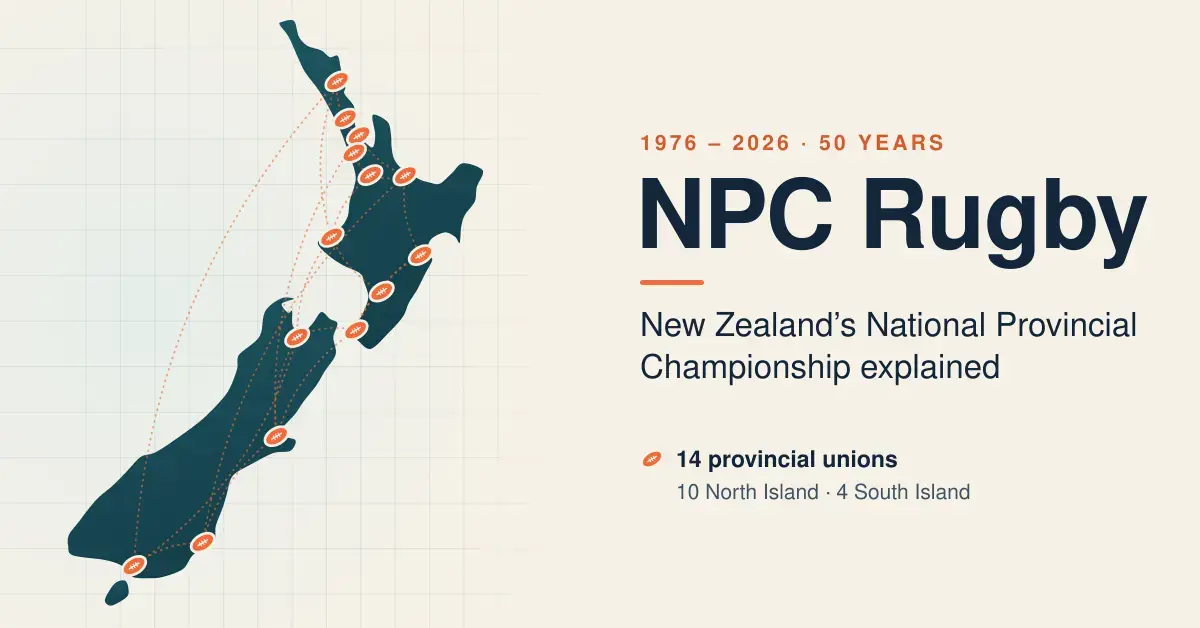
Provincial rugby sits at the heart of New Zealand’s game, and the National Provincial Championship — known from the 2026 season as the Hilux NPC — is where the country’s 14 main regional unions meet each year. First played in 1976, the competition is the bridge between club rugby and the fully professional game, and the 2026 edition marks 50 years since that opening season. This guide explains what the NPC is, how its format and finals work, which teams take part, who has won it recently, and how it connects to the Heartland Championship, the Farah Palmer Cup and the wider pathway up to Super Rugby and the All Blacks.
Key Facts
| Competition | National Provincial Championship (NPC) |
| 2026 name | Hilux NPC (Toyota Hilux naming rights) |
| Governing body | New Zealand Rugby (NZR) |
| First season | 1976 (2026 marks 50 years) |
| Teams | 14 provincial unions (10 North Island, 4 South Island) |
| Format | Single division, Odds/Evens seeding, 10-round regular season, then quarter-finals, semi-finals and a final |
| 2025 champions | Canterbury (beat Otago 36–28) |
| Most successful union | Auckland |
What is the NPC in New Zealand rugby?
The National Provincial Championship (NPC) is New Zealand’s top annual men’s provincial rugby union competition, contested by 14 regional unions for a single national title. A “provincial union” is the governing body for rugby in a defined region — for example Canterbury, Auckland or Taranaki — and each fields a representative team drawn mainly from local clubs and Super Rugby squads. The competition is run by New Zealand Rugby (NZR), the national governing body, and sits one level below the professional Super Rugby competition.
The NPC is often described as semi-professional: many players hold full-time professional contracts through Super Rugby franchises, while others are club players earning match or season payments. That mix is deliberate. The championship exists both to crown the country’s best province and to give emerging players a high-quality step up before they reach the full professional ranks.
A short history of the NPC (1976 to today)
The idea of a national inter-provincial competition was proposed by administrator Barry Smith in 1972, approved in October 1975 and launched in 1976. Before then, provincial rugby was organised around regional trophy challenges, most famously the Ranfurly Shield, which remains New Zealand’s historic provincial prize and is still defended during the NPC season.
Auckland dominated the early decades, winning a record haul of titles between the 1980s and early 2000s. The game turned professional in 1995, and Super Rugby (then Super 12) began in 1996, reshaping the player pathway. In 2006 the competition was restructured into a 14-team professional tier, with the remaining smaller unions forming the amateur Heartland Championship. Canterbury then became the dominant force through much of the 2010s.
NPC name and sponsor changes
The competition has carried several title sponsors over the years, which is why older guides still use out-of-date names. The current roll call is:
- 2006–2009: Air New Zealand Cup
- 2010–2015: ITM Cup
- 2016–2020: Mitre 10 Cup
- 2021–2025: Bunnings NPC (Bunnings Warehouse naming rights)
- 2026 onward: Hilux NPC (Toyota Hilux naming rights)
Bunnings Warehouse held the naming rights from 2021 to 2025. From the 2026 season, Toyota’s Hilux brand took over the title sponsorship of the NPC, with the change also extending across the Farah Palmer Cup and the Heartland Championship. Any reference you still see to the “Bunnings Warehouse NPC” describes the 2021–2025 era, not the current competition.
How the Hilux NPC works: format and finals
Since 2021 the NPC has been a single division of 14 teams competing for one title, with no Premiership and Championship split and no promotion or relegation. All 14 unions play in the same competition, and final standings decide who reaches the knockout rounds.
The regular season is a 10-round schedule, with each team playing five home and five away matches across roughly ten weeks from late July. A “round-robin” element means teams meet a set group of opponents during that stretch rather than everyone playing everyone once.
The Odds and Evens seeding explained
The NPC uses an “Odds” and “Evens” seeding structure, which is often misunderstood. These are not separate competitions or divisions — they are seeding groups based on the previous season’s final standings. Teams that finished in odd positions (1st, 3rd, 5th and so on) go into the Odds group, and teams that finished in even positions (2nd, 4th, 6th and so on) go into the Evens group.
During the regular season, each team plays the other sides within its own group and then a set of crossover matches against teams from the opposite group. The system is designed to balance the draw so that strong and developing sides are spread evenly, keeping fixtures competitive from week to week.
How the playoffs and final are decided
After the regular season, the leading teams advance to the knockouts: the top four from each seeding group qualify for the quarter-finals, giving an eight-team playoff. Quarter-final winners progress to the semi-finals, and the two semi-final winners meet in the NPC final. The higher-ranked side earns home advantage through the knockouts, so the best-performing team hosts the decider. There is no aggregate or two-leg system — each playoff match is a single, winner-takes-all game.
Which teams play in the NPC?
The NPC features 14 provincial unions — ten from the North Island and four from the South Island. The current line-up is:
- North Island (10): Auckland, Bay of Plenty, Counties Manukau, Hawke’s Bay, Manawatū, North Harbour, Northland, Taranaki, Waikato and Wellington.
- South Island (4): Canterbury, Otago, Southland and Tasman.
Tasman, formed from the Nelson Bays and Marlborough regions, is the newest union in the top tier and has grown into one of its strongest sides since gaining promotion in 2013. Each of these unions also feeds players into New Zealand’s five Super Rugby franchises and, ultimately, the national teams.
Recent NPC champions
Canterbury are the reigning champions, beating Otago 36–28 in the 2025 final. Auckland remain the most successful union in the competition’s history, reflecting their long period of dominance before the professional restructure. The table below lists the champions from the current single-division era.
Recent NPC Champions
| Year | Champion | Score | Runner-up |
|---|---|---|---|
| 2021 | Waikato | 23–20 | Tasman |
| 2022 | Wellington | 26–18 | Canterbury |
| 2023 | Taranaki | 22–19 | Hawke’s Bay |
| 2024 | Wellington | 23–20 | Bay of Plenty |
| 2025 | Canterbury | 36–28 | Otago |
The Heartland Championship: provincial rugby’s grassroots tier
The Heartland Championship is the amateur competition that sits alongside the NPC, giving New Zealand’s smaller rural unions a national stage. Twelve amateur unions take part — including the likes of Thames Valley, Wairarapa Bush, Whanganui, South Canterbury, North Otago, Poverty Bay, Horowhenua-Kapiti, West Coast, Buller, King Country and East Coast.
Each team plays an eight-game round-robin, after which the competition splits into two trophies: the top four contest the Meads Cup (named after All Blacks great Colin Meads) and the next four play off for the Lochore Cup (named after Sir Brian Lochore). Mid Canterbury were among the standout sides in the 2025 season. The Heartland Championship is central to keeping competitive rugby alive in rural communities and preserving long-standing regional rivalries.
The Farah Palmer Cup: women’s provincial rugby
The Farah Palmer Cup is New Zealand’s women’s provincial championship, named after Dr Farah Palmer, the pioneering former Black Ferns captain. It mirrors the men’s provincial structure and is contested across two divisions — a Premiership and a Championship — with the top sides in each advancing to semi-finals and a final. Otago Spirit won the 2025 Championship division, earning promotion back to the Premiership.
The competition is the main domestic pathway for women aspiring to the Black Ferns and has grown steadily as investment in the women’s game has increased. It also feeds the professional women’s competition, Super Rugby Aupiki.
How the NPC fits New Zealand’s wider rugby pathway
The NPC is one rung on a clear ladder: club rugby feeds the NPC, the NPC feeds Super Rugby, and Super Rugby feeds the national teams. Super Rugby Pacific is the professional cross-border competition featuring New Zealand’s five franchises (the Blues, Chiefs, Crusaders, Highlanders and Hurricanes) alongside Australian sides, the Fijian Drua and Moana Pasifika.
A common point of confusion is Super Rugby Aupiki. Despite the similar name, it is New Zealand’s professional women’s competition — not a trans-Tasman men’s event. It is contested by four New Zealand teams: Blues Women, Chiefs Manawa, Hurricanes Poua and Matatū, with the Blues Women the back-to-back champions in 2024 and 2025.
At the top of the pyramid sit the All Blacks, along with representative sides such as the Māori All Blacks. There is also a development layer below senior rugby: New Zealand runs an annual under-20 tournament built around the Super Rugby clubs, which has been branded Super Rugby Next Gen, giving the country’s most promising teenagers high-level game time before the national Under-20 programme.
Common misconceptions about the NPC
Several outdated or incorrect claims circulate about the competition. Clearing them up helps avoid confusion:
- It is no longer split into Premiership and Championship. Those two divisions were scrapped after 2020; since 2021 all 14 teams compete in a single division for one title.
- Odds and Evens are seeding groups, not separate leagues. They determine the draw based on the previous year’s finishing order, and the single NPC title is still decided across all teams.
- Super Rugby Aupiki is a women’s competition. It is not a men’s trans-Tasman event involving teams such as the Crusaders or Brumbies, as some older write-ups wrongly state.
- Bunnings is no longer the sponsor. The competition is the Hilux NPC from 2026; “Bunnings Warehouse NPC” refers only to the 2021–2025 seasons.
- The NPC and Super Rugby are different competitions. The NPC is domestic and provincial; Super Rugby is a higher, cross-border professional level.
Sources
- New Zealand Rugby – National competitions
- Provincial Rugby – NPC competition structure
- AllBlacks.com – Heartland Championship draw announced
- Otago Rugby – Otago Spirit 2025 Farah Palmer Cup Championship winners
- Super Rugby – 2026 Super Rugby Aupiki draw confirmed
- AllBlacks.com – 2026 DHL Super Rugby Pacific draw
Frequently Asked Questions (FAQ)
What does NPC stand for in rugby?
NPC stands for the National Provincial Championship, New Zealand’s top annual men’s provincial rugby union competition. It is contested by 14 regional unions and has been played since 1976. From the 2026 season it is officially known as the Hilux NPC under Toyota’s naming rights.
Who sponsors the NPC in 2026?
Toyota holds the title sponsorship of the competition from 2026 through its Hilux brand, making it the Hilux NPC. This replaced Bunnings Warehouse, which held the naming rights from 2021 to 2025. Earlier sponsors included Mitre 10, ITM and Air New Zealand.
How many teams are in the NPC?
The NPC has 14 provincial unions: ten from the North Island and four from the South Island. They all compete in a single division for one national title, with no promotion or relegation. The four South Island sides are Canterbury, Otago, Southland and Tasman.
What is the difference between the NPC and the Heartland Championship?
The NPC is the top, semi-professional tier for New Zealand’s 14 largest provincial unions, while the Heartland Championship is the amateur competition for twelve smaller, mostly rural unions. Heartland teams play for the Meads Cup and Lochore Cup rather than the NPC title.
Who has won the most NPC titles?
Auckland is the most successful union in the competition’s history, built on its long run of dominance from the 1980s into the early 2000s. In the current single-division era, Canterbury and Wellington have been the leading winners, with Canterbury the 2025 champions.