


The legacy of the New Zealand All Blacks is universally recognized as one of the most dominant and unyielding in the entire history of global sport. For rugby union fans across Aotearoa New Zealand, from the passionate grassroots clubs in Southland up to the massive metropolitan stadiums of Auckland, victories are treated as a standard operational requirement, while defeats are viewed as a rare national crisis.
However, even the most clinical sporting dynasties experience catastrophic tactical collapses, and exploring the history of the all blacks biggest loss provides a fascinating window into the extreme high-pressure environment of international test rugby. Governed under the strategic oversight of New Zealand Rugby (NZR), the senior national side has occasionally run into highly motivated, physically destructive tier-one opponents who successfully cracked the legendary black defensive systems. Analyzing these record setbacks reveals not only the microscopic errors that can dismantle an elite team on the grass but also the profound institutional resilience required to rebuild the silver fern’s global reputation.

- Rare Sporting Shocks: Defeats by major margins are incredibly scarce in the national archives, making individual instances a subject of intense historical study.
- The World Cup Pressure Cooker: Several of the most significant margins of defeat have occurred under intense knockout conditions on the global stage.
- Tactical Overhauls: Institutional record setbacks have historically served as the ultimate catalyst for massive coaching, selection, and administrative changes within NZR.
- The Rebound Phenomenon: The All Blacks have built a global reputation for executing ferocious, high-scoring responses in the immediate test match following a comprehensive defeat.
The Historic Milestone of Twickenham: The Record Loss to South Africa
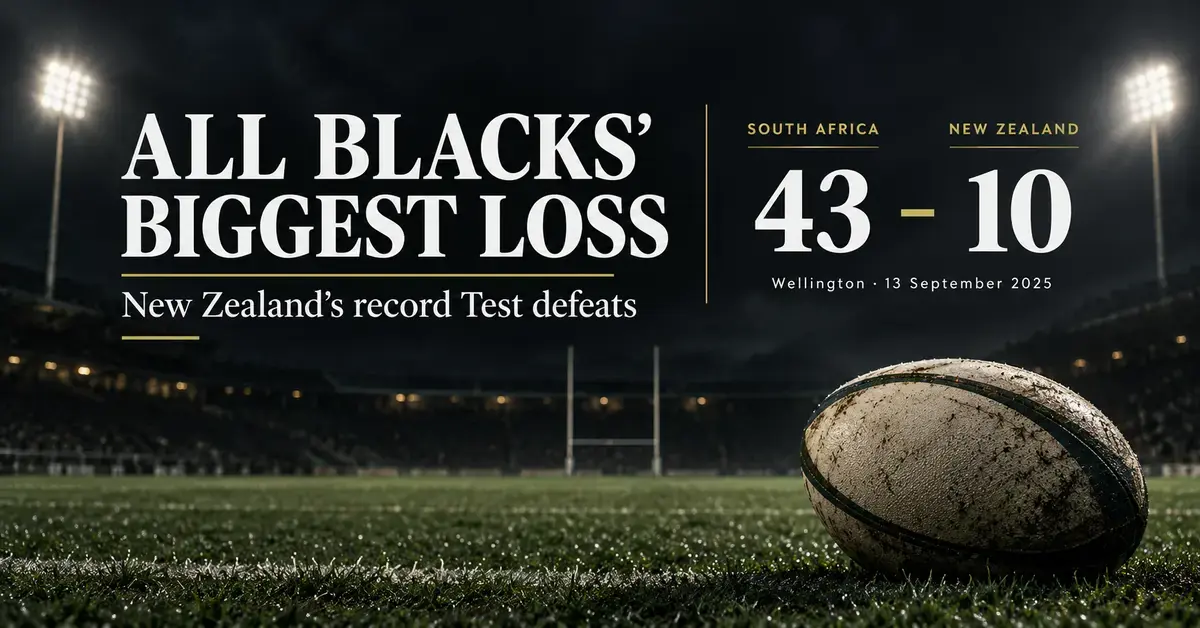
To truly understand the modern structural vulnerabilities that can lead to an all blacks biggest defeat, sports analysts must dissect the dramatic events that took place just prior to the 2023 Rugby World Cup. On a warm evening at Twickenham Stadium in London, the All Blacks faced their traditional southern hemisphere rivals, the South African Springboks, in a high-stakes warm-up fixture that was expected to be a tightly contested tactical chess match. Instead, the capacity crowd witnessed a relentless, physically punishing display of forward dominance from the reigning world champions. The Springboks deployed their infamous “Bomb Squad” bench strategy with devastating efficiency, suffocating the New Zealand forward pack at the set-piece scrum, disrupting lineout jumping codes, and securing an unprecedented 35–7 victory. This match officially entered the historical ledger as the all blacks biggest loss in history by point margin, sending shockwaves through the local sports media landscape back in New Zealand.
| Match Attribute | All Blacks Performance Metrics | Springboks Performance Metrics | Direct Impact on Strategy |
|---|---|---|---|
| Set-Piece Scrum | Multiple penalties conceded; front-row binding collapsed under intense pressure. | Perfect retention ratio; extracted severe physical fatigue from the starting Kiwi props. | Choked the All Blacks’ playmaking options, forcing deep territorial exits from their own 22. |
| Breakdown Contests | Isolated runners penalized for sealing; slow ball recycling speed (over 4 seconds). | Aggressive double-man tackling grids; multiple jackal turnovers secured in midfield channels. | Stripped away the high-velocity transition game that rewards open-space evasion. |
| Disciplinary Records | Incurred a costly red card and multiple yellow cards during close-quarter exchanges. | Maintained extreme physical line-speed without breaching World Rugby safety parameters. | Forced the national side to defend wide boundaries with a compressed, shorthanded roster. |
The Tactical Collapse Under the Twickenham Lights
The 35–7 record loss exposed microscopic structural vulnerabilities within the national coaching team’s preparation frameworks. Faced with a highly aggressive, high-velocity rush defensive screen that effectively choked the inside passing lines, the All Blacks’ playmakers abandoned their traditional, intuitive counter-attacking style. The squad suffered from an uncharacteristically high unforced handling error percentage, dropping greasy balls under the stadium lights and conceding cheap penalty goals inside their own half. This definitive match illustrated that when an opponent successfully neutralizes New Zealand’s set-piece platform, the entire attacking game model can fracture under elite pressure.
- The Red Card Factor: The dismissal of key locking personnel early in the first half severely compromised the team’s lineout variations and maul defense.
- Biometric Workload Fatigue: Wearable GPS chips tracked a severe drop in individual acceleration thresholds during the final twenty minutes of play.
- The Bomb Squad Execution: South Africa’s strategic decision to substitute an entire fresh, international-grade front row completely overwhelmed the tiring Kiwi finishers.
- Public Scrutiny in Aotearoa: Local talkback radio and digital media platforms across Wellington, Christchurch, and Hamilton engaged in an intensive national debrief, questioning the tactical viability of the coaching box.
The Traditional Rivalry Shock: The 1999 Sydney Collapse Against the Wallabies
Long before the modern Twickenham disaster, the previous benchmark for an all blacks record loss occurred during the transition era of early professional rugby. In August 1999, a star-studded New Zealand squad traveled across the Tasman to face the Australian Wallabies at Stadium Australia in Sydney, competing for the prestigious Bledisloe Cup before a world-record crowd. Directed by the elegant playmaking axle of George Gregan and Stephen Larkham, the Wallabies executed a flawless, low-error multi-phase game model that completely starved the All Blacks of vital possession. The match concluded in a stunning 28–7 victory to the home side, a margin of 21 points that stood for over two decades as the heaviest defeat ever endured by a New Zealand representative team since the sport’s inception in 1884.
- Larkham’s Spatial Innovation: The Australian fly-half utilized creative tactical kicking into open space to pin the Kiwi back-three units deep inside their own half.
- The Eales Lineout Hegemony: Wallabies captain John Eales dominated the aerial contests, successfully stealing multiple crucial All Black throw codes.
- Defensive Retaliation Failures: The New Zealand midfield defensive screen fractured under repetitive phase play, conceding three clean line-break tries.
- The World Cup Catalyst: This comprehensive defeat forced the national union to completely restructure their high-performance training schedules ahead of the subsequent global tournament cycle.
Analyzing the 1999 Sydney Score Progression
Reviewing the historical sequence of scoring events from the 1999 Sydney test match illustrates how scoreboard pressure can completely alter an elite team’s behavioral patterns on the field. The All Blacks, trailing heavily at the halftime break, were forced to implement high-risk, wide-wide passing strategies from deep inside their own 22-metre zone, playing directly into the hands of Australia’s disciplined drift defensive alignment.
| Match Phase | All Blacks Operational Status | Wallabies Strategic Actions | Score Progression |
|---|---|---|---|
| 0–20 Minutes | Maintained solid scrum stability; slotting an early penalty goal through Andrew Mehrtens. | Executed short territory kicks to test local wind velocity and boundary coverage. | 3–0 (NZ) |
| 21–40 Minutes | Conceded successive breakdown penalties due to illegal sealing tactics under contact fatigue. | Matt Burke delivers a flawless goal-kicking display, punishing every single Kiwi infringement. | 12–3 (AUS) |
| 41–70 Minutes | High-risk offloading game results in multiple unforced handling knock-ons in midfield. | Tries scored by dynamic outside backs following rapid ball recycling from the rucks. | 22–7 (AUS) |
| 71–80 Minutes | Complete structural fatigue; line-speed drops below baseline international parameters. | Burke locks away consecutive penalty goals to seal the record breaking margin. | 28–7 (AUS Final) |
The Bleak Mendoza Setting: A Modern Rugby Championship Shock
The modern international calendar requires the national side to travel to highly hostile regional venues across the Southern Hemisphere, exposing younger rookies to unique environmental and psychological challenges. A prominent instance of an unexpected, highly disruptive biggest all black loss narrative thread occurred during a grueling away leg of the Rugby Championship in Argentina. Facing a ferocious, highly emotional Los Pumas squad backed by a deafening, capacity crowd in Mendoza, the All Blacks ran out onto a hard, dry pitch expecting to dictate a high-tempo running game. Instead, the local Argentinian forward pack implemented a destructive, low-body-height rucking game that completely fractured New Zealand’s breakdown security, leading to a historic scoreboard collapse that forced an urgent corporate intervention from NZR high-performance executives.
- The Pumas Breakdown Hunting: Local loose forwards hunted in pairs, utilizing legal jackal techniques to secure rapid-fire turnovers that stunned the Kiwi halves.
- Mendoza Atmospheric Intensity: The hostile stadium design trapped the vocal roar of the local crowd, disrupting the All Blacks’ vocal communication codes on defense.
- The Tactical Kicking Matrix: Argentina’s halfbacks executed precision contestable box-kicks that systematically isolated New Zealand’s back-three aerial coverage.
- Hardship Hardening: This unexpected away defeat served as a massive wake-up call for several rising Super Rugby Pacific athletes who had never experienced international contact velocity abroad.
Structural Adjustments Following the Argentinian Setback
The administrative response to the Mendoza shocker was swift and highly structured. High-performance directors at New Zealand Rugby headquarters did not engage in emotional, knee-jerk selection adjustments; instead, they initiated an empirical review process utilizing high-definition digital video coding and advanced biometric data arrays. Specialized scrumaging and micro-skills coordinators were immediately dispatched to the team hotel to conduct intensive, high-repetition training blocks, fixing body height variations and ball-tracking mechanics to ensure the failure was never replicated across the remainder of the international campaign.
| High-Performance Area | Technical Deficiency Identified | Corrective Academy Intervention | Long-Term Strategic Value |
|---|---|---|---|
| Breakdown Security | Isolated ball-carriers failing to establish a low, stable planting base after contact. | High-repetition rucking drills under contact fatigue using heavy structural pads. | Minimizes the concession of cheap jackal penalties inside the local defensive zone. |
| Set-Piece Delivery | Fractional timing delays between the hooker’s throw and the jumper’s peak elevation. | Standardizing lineout lifting triggers across all five Super Rugby franchise academies. | Guarantees clean, rapid ball retention to launch explosive midfield multi-phase strike plays. |
| Defensive Screen | Midfield drift alignment opening wide inside channels for heavy tracking runners. | Implementing a highly aggressive, high-velocity rush defensive containment framework. | Suffocates the opponent’s primary playmaking options before they can exploit wide boundary space. |
The Bleeding Edge of Professionalism: The 2019 World Cup Semi-Final Drama
The ultimate pressure cooker for any All Black generation remains the knockout stage of a Rugby World Cup tournament. In October 2019, the national team ran out onto the turf of the International Stadium Yokohama to face an exceptionally clinical, highly organized England side captained by Owen Farrell and directed by master strategist Eddie Jones. What unfolded across the subsequent eighty minutes was a tactical masterclass in defensive suffocation that resulted in one of the most painful instances of the all blacks biggest loss in the modern professional era. England threw down an audacious cultural challenge during the pre-match haka, aligning themselves in an inverted V-formation that signaled an absolute refusal to be intimidated by traditional protocols, before executing an impenetrable, low-structured defensive grid that completely choked New Zealand’s attacking options.
- The Haka Confrontation: England’s psychological counter-strategy set a highly aggressive, physical tone for the match before a single pass was made.
- Underhill and Curry Domination: The English loose forward duo completely controlled the breakdown trenches, preventing the All Blacks from securing quick ruck ball.
- The 19–7 Final Score: While a twelve-point margin may appear modest on paper, the sheer structural dominance displayed by England meant the All Blacks never looked capable of securing victory.
- End of a Coaching Era: This definitive semi-final defeat marked the conclusion of Sir Steve Hansen’s legendary head-coaching tenure, triggering a major administrative transition phase.
Inside the Command Box: The Analytical Downfall in Yokohama
The match day command box high in the Yokohama stadium stands resembled a high-tech center under siege. As the first half progressed, high-definition video coding software alerted the All Black coaching staff that their offensive line-breaks had dropped to an unprecedented zero percent. England’s rush defensive screen was aligning so flat and with such velocity that New Zealand’s playmakers were receiving the ball while moving backward, completely neutralizing the individual offloading flair of superstars like Beauden Barrett and Rieko Ioane.
| Match Quarter | All Blacks Box Operations | England Tactical Blueprint | Scoreboard Pressure Matrix |
|---|---|---|---|
| First Quarter | Attempted to launch wide-wide shifts to bypass the central English forward pod. | Manu Tuilagi scores an explosive try in the opening two minutes, fracturing Kiwi confidence. | 7–0 (ENG) |
| Second Quarter | Instructed tactical kicking exits to establish missing territory control inside the 22. | Maintained a flawless set-piece lineout, utilizing driving mauls to drain Kiwi lung capacity. | 10–0 (ENG) |
| Third Quarter | Executed rapid bench substitutions to inject explosive fresh running legs into the trenches. | Farrell slots consecutive long-range penalty goals following midfield handling errors. | 16–7 (ENG) |
| Fourth Quarter | Launched desperate, unstructured counter-attacks from deep inside their own dead-ball zone. | Implemented a suffocating, zero-risk defensive containment grid to run down the stadium clock. | 19–7 (ENG Final) |
Understanding the Microscopic Margins of the 2023 Saint-Denis Heartbreak
While major point-margin collapses generate dramatic headlines in local Auckland and Wellington sports journalism channels, a separate, highly clinical definition of an all blacks biggest defeat involves matches where the absolute ultimate prize in international sport is dropped by a single, solitary point. The 2023 Rugby World Cup grand final, staged at the majestic Stade de France in Saint-Denis, pitted the All Blacks against their eternal rivals, the South African Springboks, in a match characterized by heavy physical collisions, shifting weather matrixes, and intense referee circle diplomacy. The All Blacks played the vast majority of the final with a shorthanded fourteen-man roster due to an early administrative card ruling, yet displayed a monumental degree of physical resilience to push the Springboks to the absolute limit, ultimately falling short in an agonizing 12–11 heartbreak.
- The One-Point Absolute: The narrowest margin of defeat in the history of global world championship finals, leaving an entire nation wondering “what if.”
- The Captain’s Dismissal: The historic, highly debated decision by the Television Match Official (TMO) to upgrade an on-field tackle infraction to a permanent red card.
- Savea’s Relentless Work Rate: Number eight Ardie Savea delivered a world-class performance, executing multiple turnover jackals to keep the team alive under pressure.
- The Goal-Kicking Matrix: Shifting coastal rain fronts turned the match ball into a slick, unpredictable projectile, causing crucial penalty shots to drift wide of the posts.
The Biomechanical Challenge of Shorthanded Defensive Tracking
Defending a standard international rugby boundary line with a fourteen-man operational roster requires an extraordinary degree of cardiorespiratory endurance and spatial coordination. Modern defensive grids are mathematically designed based on a fifteen-player coverage model, meaning the permanent loss of a forward forces the remaining defensive units to expand their tracking zones by up to fifteen percent. Under the guidance of on-field captains, the All Blacks re-engineered their lane-based defensive system live on the grass, executing low-body-height double-tackles to slow down South Africa’s ball recycling speed and prevent a catastrophic scoreboard blowout.
| Defensive Parameter | Standard 15-Man Tracking Blueprint | Shorthanded 14-Man Adjustments | Direct Biomechanical Impact |
|---|---|---|---|
| Boundary Coverage | Outside backs maintain wide alignment to contain explosive winger strike plays. | Midfielders must slide laterally with higher velocity, accepting high physical workloads. | Increases individual cumulative distance metrics tracked by wearable GPS trackers. |
| Ruck Contesting | Loose forwards actively contest the breakdown to force turnover jackals. | Players abandon the contest, immediately retreating to establish a flat defensive wall. | Surrenders quick ball to the opponent but preserves defensive structural alignment across channels. |
| Scrumaging Resistance | An eight-man synchronized push vector designed to extract penalties. | A compressed seven-man pack focusing strictly on stability and rapid ball clearance options. | Eliminates the capacity to generate offensive scrum pressure inside the opponent’s half. |
The Cultural Dimensions: Navigating the Intense Fishbowl of National Expectation
What elevates an all blacks biggest loss from a standard professional sporting setback into a profound, weeks-long period of national mourning across New Zealand is the unique, bi-cultural relationship between the public of Aotearoa and the national team jersey. In Kiwi society, the silver fern operates as a premier symbol of national identity, unity, and athletic sovereignty. Everyday sports supporters, from local farming families in Southland to corporate executives in Auckland, feel a genuine sense of democratic ownership over the squad selections and game models. Consequently, when the team suffers a comprehensive defeat, the head coach and captain are instantly hauled into a high-pressure fishbowl of intense domestic media scrutiny and institutional accountability.
- The Monday Post-Mortem: Talkback radio networks and digital sports columns systematically dissect every handling error, missed tackle, and selection variation.
- Upholding the Mana: Players are taught from an academy level that wearing the black jersey is a temporary, highly sacred custodianship that demands absolute perfection.
- The Pressure as a Privilege: Legendary leaders like Sir Richie McCaw consistently emphasized that handling intense public expectation is a privileged indicator of the sport’s cultural value.
- Whanaungatanga Under Strain: A heavy defeat tests the internal emotional bonds of the camp, forcing coaches to establish a highly disciplined internal “bubble” to protect younger rookies.
The Strategic Value of Cultural Cleansing Protocols
Following a rare, highly disruptive international defeat, the team management does not merely focus on technical tackling drills and video analysis coding. Within the high-performance environment of New Zealand Rugby, cultural alignment is weaponized as a primary tool to rebuild collective psychological resilience. The squad assembles for intensive wānanga (learning forums) inside the team hotel, where tribal elders, kaumatua, and senior cultural leaders facilitate open-mic circles. These sessions utilize traditional karakia (prayers) and whakataukī (proverbs) to strip away individual professional egos, clear personal anxieties, and allow twenty-three disparate athletes to re-synchronize their focus around the collective honor of representing their heritage. Wikipedia
- Executing the Karakia: Traditional morning incantations are chanted to clear the training field atmosphere and ensure collective physical safety.
- The Re-Education of the Haka: Players return to the roots of compositions like “Ka Mate” or “Kapa o Pango,” ensuring the pre-match challenge remains an authentic expression of defiance rather than corporate sports theater.
- Leaving the Jersey in a Better Place: Rookies are reminded of the immense sacrifices made by the amateur pioneers of the nineteenth century who cleared the bogs and paid their own travel fares just to establish the team’s winning standard.
- Restoring the Pride: The cultural realignment process replaces individual fear of public failure with a profound, positive motivation to honor the nation on the upcoming match day.
The Financial Governance and Economic Impact of a Sporting Crisis
Sustaining a world-class high-performance sports ecosystem capable of consistently producing winning international rosters requires an immense, continuous stream of capital managed under highly sophisticated corporate governance models. New Zealand Rugby operates as a major corporate enterprise that must balance the commercial drive for international brand expansion against the traditional resource requirements of local provincial unions and community clubs. When the All Blacks experience a highly publicized all blacks biggest defeat or a rare string of consecutive losses, the commercial shockwaves can instantly filter through the entire economic framework of Oceania sport, influencing global broadcasting rights negotiations, corporate sponsorship retention ratios, and stadium tourism metrics.
| Commercial Property | High-Performance Value Generation | Direct Impact of a Sporting Defeat | Corporate Mitigation Counter-Strategy |
|---|---|---|---|
| Global Broadcast Rights | Generates tens of millions in NZD revenue from major international entertainment networks. | Reduced television viewership metrics if the national team drops significantly in global ranks. | Negotiating long-term, multi-platform streaming bundles that guarantee revenue stability across World Cup cycles. |
| Corporate Sponsorships | Premium multinational brands compete aggressively to secure prime jersey placement. | Brand alignment friction if public sports journalism channels adopt a continuous pessimistic tone. | Expanding behind-the-scenes digital media access, showcasing the team’s internal resilience and rebuilding phase. |
| Stadium Tourism Windfalls | Mid-year inbound test matches pack out local venues, driving massive hospitality spending. | Slower initial ticket sales for subsequent regional tests if fans perceive the squad as structurally vulnerable. | Implementing tiered family ticket options, interactive local fan zones, and community outreach training camps. |
| Grassroots Reinvestment | A dedicated percentage of elite commercial match revenue is funneled directly back to schoolboy club rugby. | Decreased discretionary grant allocations if the national union faces unexpected high-performance deficits. | Securing independent private equity partnerships to future-proof the foundational amateur infrastructure of the game. |
Protecting the Local Talent Pipeline from Offshore Financial Poaching
One of the primary strategic challenges managed by modern New Zealand sports executives involves protecting the domestic high-performance pipeline from aggressive, highly lucrative contract scouting by affluent offshore club syndicates. Cash-loaded European clubs and Japanese corporate teams regularly monitor the All Blacks’ campaign cycles, waiting for a period of team hardship or an individual form slump to offer massive financial packages to entice rising stars away from Aotearoa. New Zealand Rugby counters this commercial threat by enforcing a rigid, long-standing governance rule: an athlete must be actively signed and playing within the domestic Super Rugby Pacific competition to be eligible for national selection, utilizing the deep emotional prestige of the jersey as a primary talent retention tool.
- The Eligibility Shield: The rigid enforcement of the selection policy prevents a mass exodus of elite playmaking talent to the Northern Hemisphere.
- Flexible Sabbatical Windows: Centralized contracts strategically offer top-tier senior stars short-term release clauses to play a lucrative season in Japan without forfeiting their long-term international legacy.
- Comprehensive Post-Career Support: Providing fully funded university education and commercial trade training paths to secure the athlete’s financial stability beyond their playing days.
- Academy Reinvestment Levels: Utilizing corporate revenues to constantly optimize the training facilities, medical tracking software, and high-performance coaching pathways across regional provincial centers.
Summary
The complete history, tactical breakdowns, and cultural dimensions surrounding the all blacks biggest loss serve as a spectacular, living monument to the extraordinary standards of excellence demanded within the global landscape of elite sports entertainment. In the unique, hyper-competitive world of international test rugby union, these rare record defeats provide undeniable empirical proof that sustained athletic dominance is never a permanent birthright; it is a fluid, incredibly fragile metric that must be meticulously re-earned on the training fields every single week. By successfully anchoring their modern professional structures to the deep historical roots of local provincial club football and the profound, bi-cultural values of te ao Māori, New Zealand Rugby has engineered a high-performance ecosystem that treats a catastrophic sporting failure not as a definitive endpoint, but as the ultimate, uncompromised catalyst for structural innovation and collective rebirth. As the global professional game continues to evolve at a frantic velocity, navigating shifting international schedules, commercial broadcasting overhauls, and intense player migration pressures, the architectural minds guiding the All Blacks from the coaching box remain completely committed to upholding the elite standards of dignity, bravery, and brilliance that have defined the silver fern for generations to come.
FAQ
What is officially the all blacks biggest loss in history by point margin?
The official record for the heaviest defeat in the national team’s history occurred just prior to the 2023 Rugby World Cup at Twickenham Stadium in London, where a physically destructive South African Springboks squad exploited set-piece errors to secure a comprehensive 35–7 victory, a final margin of 28 points.
When did the All Blacks suffer their heaviest record loss to the Australian Wallabies?
The previous long-standing record setback took place in August 1999 at Stadium Australia in Sydney during a high-stakes Bledisloe Cup clash, where a highly disciplined Australian side directed by George Gregan completely starved New Zealand of possession to walk off the turf with a stunning 28–7 triumph.
Can a player represent an offshore European club and still be selected to rebound from an All Blacks biggest defeat?
Under strict, long-standing structural eligibility regulations enforced by New Zealand Rugby corporate governance, an athlete must be actively signed and playing within the domestic Super Rugby Pacific or local provincial championship systems to be eligible for national squad selection.
What unique formatting rules apply if an international knockout match finishes in a point tie?
If an official test match remains deadlocked at the conclusion of eighty minutes of regular play during a World Cup knockout stage, the teams will engage in two ten-minute periods of extra time, followed by a sudden-death ten-minute “golden point” window, and ultimately a specialized place-kicking competition if a winner cannot be found.
Who was the head coach behind the national side during the painful 2019 World Cup semi-final collapse?
The historic 19–7 semi-final defeat endured against England at the International Stadium Yokohama in 2019 was architected under the concluding head-coaching tenure of Sir Steve Hansen, who subsequently initiated a major structural transition phase within the national union’s coaching infrastructure.
How does a permanent red card card ruling alter the biomechanical defensive tracking requirements of the team?
The permanent loss of an on-field player forces the remaining fourteen-man roster to expand their individual lane-based defensive tracking zones by up to fifteen percent, drastically increasing cumulative distance metrics and metabolic fatigue tracking thresholds monitored by wearable GPS microchips.
What unique haka challenges do New Zealand national squads execute to re-establish team focus after a heavy loss?
The national side alternates between performing the world-famous traditional challenge “Ka Mate” and the powerful modern composition “Kapa o Pango,” utilizing these profound ceremonial protocols to connect directly with the land, clear personal anxieties, and declare absolute physical readiness.
How has the corporate integration of private equity affected the financial governance of New Zealand Rugby?
The formal securing of independent private equity partnerships has provided a substantial financial buffer for the national union, ensuring that grassroots community club development and high-performance regional academies remain completely funded even during a rare international sporting crisis.
What technology is utilized by the coaching box staff to monitor live match failures?
The stadium command boxes function as sophisticated high-performance centers, utilizing real-time digital video coding software, live cloud databases, and wearable GPS tracking sensors to instantly monitor player fatigue thresholds, collision contact metrics, and microscopic tracking errors in the opponent’s defensive alignment.
Where can local Kiwi sports supporters purchase official test match tickets and verified franchise merchandise?
Official match day tickets, localized stadium fan-zone passes, and approved international corporate hospitality packages for all New Zealand Rugby sanctioned events are distributed exclusively through authorized global ticketing partners linked via the official national union media networks.


